The 45 Chair | Finn Juhl | 1945
Please note that the versions shown here represent only a selection of the many available options. For a complete overview of colors and materials, please explore the material page.
The 45 Chair | Finn Juhl | 1945
In the fall of 1945, Finn Juhl unveiled the 45 Chair at the Copenhagen Cabinetmakers' Guild Exhibition. With this chair, he introduced a groundbreaking design separating the carried from the carrying elements – something previously unseen. Today, the chair is widely regarded as one of the most revolutionary and iconic pieces in Danish furniture design. The chair is upholstered by hand in Denmark in textile or leather. The frame is available in oak or walnut.
Wood Type
-

Walnut
-

Oak Dark Oil
-

Oak Clear Oil
Upholstery
Écriture
-

570 / 240
-

240 / 380
-

270 / 240
-

380 / 570
Safire
-

002
-

004
-

007
Vidar
-

222
-

152
-

182
-

443
-

472
-

582
-

633
-

723
-

1062
-

1511
Leather
-

Elegance Walnut
-

Elegance Black
-

Vegetal Nature
Hallingdal
-

100
-

103
-

110
-

113
-

227
-

376
-

457
-

764
-

960
-

980
Remix
-

123
-

163
-

183
-

242
-

412
-

443
-

612
-

762
-

823
-

933
Watercolour
-

Butterscotch Yellow
-

Cast Iron
-

Dark Conifer
-

Fresh Sage
-

Golden Syrup
-

Himalaya
-

Peacock
-

Pumpkin Spice
-

Rose Quartz
-

Silver Azure
-

Soft Linen
In the fall of 1945, Finn Juhl unveiled the 45 Chair at the Copenhagen Cabinetmakers' Guild Exhibition. With this chair, he introduced a groundbreaking design separating the carried from the carrying elements – something previously unseen. Today, the chair is widely regarded as one of the most revolutionary and iconic pieces in Danish furniture design. The chair is upholstered by hand in Denmark in textile or leather. The frame is available in oak or walnut.
Product information
- Design:
- Finn Juhl
- Year:
-
1945, relaunched in 2003
- Materials:
-
Frame: Oak or walnut
- Upholstery:
- Textile or leather
- Model and dimensions:
- FJ 4500
- W: 66.5 cm | D: 73 cm | H: 85 cm
- Seat height: 44 cm

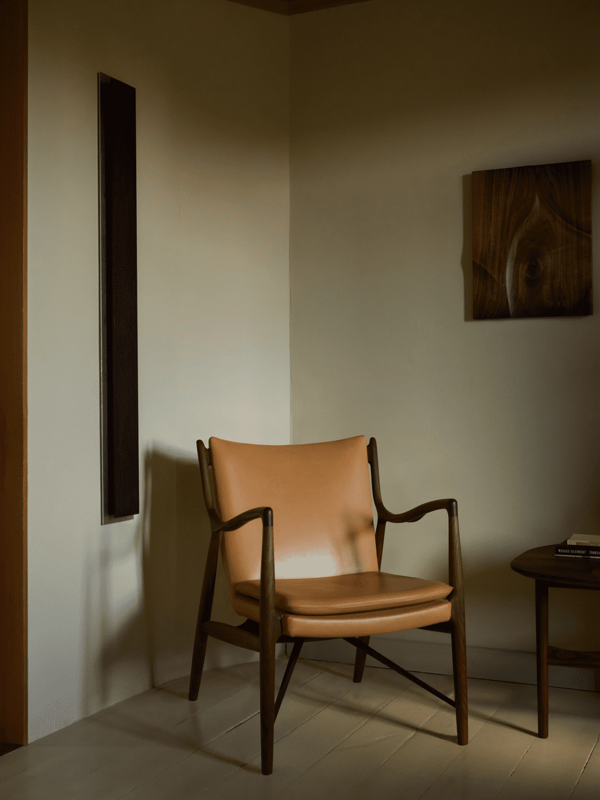
The 45 Chair in walnut with 'Vegetal' leather upholstery.
The Beginning of a Design Revolution
A Defining Silhouette
On the 45 Chair, the space between the frame and the seat creates a sense of lightness which, combined with its organic shape and refined detailing, gives the chair a unique beauty and floating elegance. The chair appeals to all the senses, pleasing both eye and body, and it has even been called “the mother of all modern chairs” by Japanese professor and design collector Mr. Noritsugu Oda.
The groundbreaking 45 Chair marked the beginning of Finn Juhl’s distinctive design language, which came to full expression in the late 1940s. During this period, his work was defined by the liberation of the seat and backrest – designed as a single unit, carried independently by the frame. This bold approach became a defining moment in establishing Finn Juhl as a true pioneer in furniture design.

The 45 Chair in walnut with 'Elegance' leather in the color 'Black'. Credits: The Monocot Shop / JUST BUILD LTD / Studio Periphery

The 45 Chair in walnut with 'Vegetal' leather upholstery.

Finn Juhl's own 45 Chairs in his house north of Copenhagen.

The 45 Chair in walnut with 'Nalia' upholstery in the colour '0430'. Photo: Elisabeth Heltoft for Sahco
From Experiment to Icon
Immediate Acclaim
While Finn Juhl had already begun exploring the idea of separating the upholstered and wooden elements in earlier works, the 45 Chair marked a turning point. Its sculptural backrest and fluid, organic form elevated the concept to new heights, firmly establishing Finn Juhl as a leading figure in 20th-century design.
In a review of Finn Juhl's stand at the Cabinetmakers' Guild Exhibition in 1945, the architect Erik Herløw wrote:
"In the early years, Finn Juhl's attempts seemed exaggerated, but now it is much more interesting to observe the result he has achieved by going his own ways. Most beautiful is an armchair, where the frame is organically shaped as a bone, able to support the muscles of an arm and the weight of a body. The expression of the chair is reminiscent of a weapon, sharpened by human hands."

Finn Juhl's original watercolor depicting the 45 Chair from 1945. Photo credit: Pernille Klemp, Designmuseum Danmark


